Ballistic Media

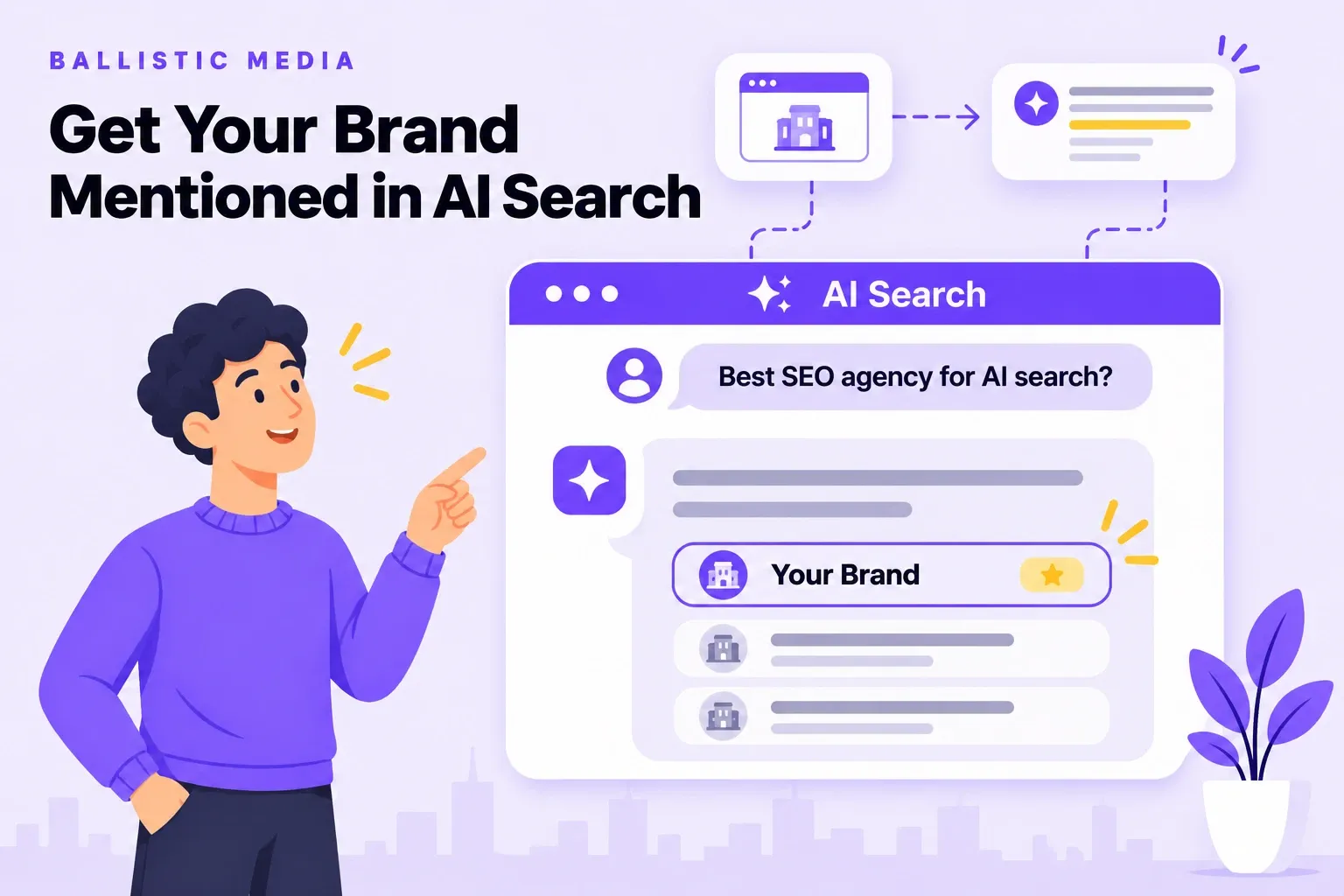
Buyers increasingly find companies by asking ChatGPT, Gemini, Perplexity, Microsoft Copilot or Google's AI Overviews. They describe a problem, get a short list of names, and start their research from there.
Ranking first on Google and being named by an AI system are related, but they aren't the same thing. Plenty of brands rank well and still never appear in AI answers. Others are named regularly even though their own website barely ranks.
So the real question is: what makes an AI system recognise, trust and mention one brand instead of another?
This guide answers that with practical actions, not tricks. There's no switch you can flip to make ChatGPT recommend you, and anyone selling one is selling a shortcut that won't last. What you can do is make your brand easy to understand, well supported across the web and genuinely worth mentioning.
Key takeaways
- AI systems mention brands they can understand, verify and connect to the question being asked.
- What other people say about you matters more than what you say about yourself. In Ahrefs' study of 75,000 brands, branded web mentions correlated far more strongly with AI Overview visibility than backlinks did.
- Consistency is underrated. If your website, profiles and third-party coverage describe you differently, AI systems get less confident about what you actually do.
- Check the basics first: if your CDN or robots.txt blocks AI search crawlers, the rest of your work can't be seen.
- Traditional SEO still matters. Strong organic visibility supports AI visibility, but it doesn't guarantee a mention.
- Nobody can guarantee an AI mention. You can increase the number and quality of signals that connect your brand with the topics you want to be known for.
What does it mean to be mentioned in AI search?
Being mentioned in AI search means an AI-generated answer names your brand when someone asks a relevant question. It might be a recommendation, a comparison, a list of options or a direct answer about your company.
Typical prompts where brands get mentioned:
- "Best SEO agencies in Dubai"
- "Which companies offer Webflow development in the UAE?"
- "Best project management software for small agencies"
- "Alternatives to [competitor]"
It helps to separate two outcomes:
| Outcome | What happens | Why it matters |
|---|---|---|
| Brand mention | The AI names or recommends your company | This is what shapes the buyer's shortlist |
| Citation | The AI links to your website or content as a source | This shows the AI trusts your content as evidence |
You can be cited without being recommended, and recommended without being linked. This guide focuses on mentions. If you want to measure both, our guide on how to measure GEO and AI search visibility covers the metrics in detail.
How do AI search engines decide which brands to mention?
There is no single "AI ranking factor", and no published list of signals for any platform. Different systems work differently. Some lean heavily on what a model learned in training. Others search the web in real time before answering. Most do some of both.
What we can say is that AI search systems draw on signals from places like:
- Search engines and web indexes
- The brand's own website
- Third-party websites
- Reviews and reputation
- News and publications
- Industry directories and databases
- Expert articles and discussions
- Structured, clearly written information about the company
The evidence points strongly towards off-site signals. In Ahrefs' analysis of 75,000 brands, the factors most closely linked to appearing in AI Overviews were all off-site: branded web mentions, branded anchor text and branded search volume. Backlinks showed a much weaker relationship. That's a correlation, not proof of cause, but it matches what we see in practice.
The key point is simple: AI systems need to understand who your brand is, what it does, and why it's relevant to the question being asked. Every action below supports one of those three things.
1. Make your brand easy for AI systems to understand
AI systems can only mention you accurately if they can work out what you are. Clear brand and entity information is the foundation.
Your website should state, plainly and consistently:
- Your company or brand name
- Your services or products
- The industries you serve
- The locations you serve
- Your areas of expertise
- Team and company information
- Contact information
The pages that carry most of this are your About, Services, Locations, Case Studies and Team pages. Organisation schema markup can reinforce the same facts in a machine-readable form.
The biggest problem we see is vague positioning:
| Vague | Clear |
|---|---|
| "We craft future-ready digital experiences for bold brands." | "Ballistic Media is a digital growth agency for SaaS, fintech and AI companies, offering SEO, AI search optimisation, Webflow and Next.js development, and performance marketing." |
The first sentence could describe almost any agency. The second tells a person, a search engine and an AI system exactly what the company does and who it's for.
Then check consistency. Your LinkedIn page, Google Business Profile, Clutch listing, directory profiles and old press coverage should describe the same company, with the same services, locations and positioning. If five sources describe you five different ways, an AI system has to guess, and it may simply leave you out.
2. Build strong topic authority around what you want to be known for
Don't publish random articles just for traffic. AI systems connect brands to topics through repeated, consistent evidence.
If you want AI systems to associate your brand with AI SEO, for example, build a body of genuinely useful content around it:
- What is AI SEO?
- GEO vs SEO
- How to optimise for AI Overviews
- How to track brand mentions in ChatGPT
- An AI search visibility checklist
- Traditional SEO vs AI search optimisation
Topic authority comes from three things working together: a strong service page that says what you offer, supporting educational content that shows you understand the subject, and real expertise that proves you've done the work. For a working example of this structure, see how our AI search optimisation service connects to the guides on this blog.
3. Get your brand mentioned beyond your own website
This is the most important section in this guide.
A company saying "we're the best" on its own website isn't strong evidence. A respected industry publication, a client's case study, an independent review or a conference programme saying it is.
Earn legitimate mentions from:
- Industry publications
- Relevant directories
- Partners
- Associations
- Podcasts and interviews
- Conferences and events
- Expert contributions
- News and media
- Research or studies
- Other authoritative websites in your niche
Relevance beats volume. One mention in a publication your buyers actually read does more than a hundred low-quality directory listings or bought links. Start by checking which sources AI platforms already cite for your category's prompts. Those pages are your priority list for PR, partnerships and outreach. If you work in fintech, for example, a specialist fintech PR agency can help you earn coverage in the publications those answers draw on.

Brand mentions vs backlinks
A backlink is a link from another site to yours. A brand mention is any reference to your brand, linked or not.
In traditional SEO, links get most of the attention. For AI visibility, a mention can still help establish the relationship between your brand and a topic even without a link, because language models learn from the text itself: which names appear, in what context, next to which topics.
That doesn't mean every unlinked mention improves your AI visibility. A passing name-drop on an irrelevant page is unlikely to do much. Aim for mentions that place your brand in the right context: the right topic, the right category, described accurately. Earn the link too when it's natural, because it helps both search engines and readers.
4. Create content worth citing
AI answers need evidence. Generic content gives them nothing new to use. Original information gives them a reason to cite you, and gives other sites a reason to mention you.
Citation-worthy content includes:
- Original research
- Industry statistics
- Surveys
- Benchmarks
- Experiments
- Detailed comparisons
- Case studies
- Original frameworks
- Expert explanations
- Useful tables and data
| Generic content | More citation-worthy content |
|---|---|
| SEO Tips for 2027 | SEO CTR Study Based on 500 Websites |
| Benefits of Webflow | Webflow vs WordPress: Performance Test |
| AI SEO Guide | AI Search Visibility Study Across 100 Brands |
These are illustrative titles. The point is the pattern: the right-hand column contains something that only exists because someone did the work.
If you publish comparisons or "best of" lists, be transparent about your criteria and fair to competitors. AI systems pull heavily from comparison content, and readers can tell the difference between a useful comparison and a disguised sales page.
5. Show real experience and expertise
This is where Google's E-E-A-T principles (experience, expertise, authoritativeness and trust) become practical. Readers and AI systems both look for signs that content was written by someone who actually knows the subject.
Include:
- Named authors
- Author experience and credentials
- Real examples
- Screenshots
- Original observations
- Client results, where clients have given permission
- Case studies
- Clear company and team information
The test is simple: add information that could only come from someone who has actually done the work. If a competitor could publish your article by changing the logo, it isn't adding much evidence about you.
6. Answer the questions people actually ask AI
People type short keywords into Google. They ask AI tools longer, more conversational questions, often with context about their situation.
Instead of targeting only "SEO agency UAE", consider content that answers:
- Which SEO agency is best for B2B companies in the UAE?
- How much does SEO cost in Dubai?
- SEO agency vs in-house SEO team
- How do I choose an SEO company?
- Which agencies specialise in technical SEO?
Traditional keyword research is still useful. Add question research on top: long queries in Search Console, People Also Ask, questions from sales calls and support tickets, and the comparisons buyers raise in reviews and forums. Then answer them directly, with the answer near the top of the page and the detail underneath.
7. Strengthen your brand reputation
AI systems often summarise what the wider web thinks of a company. Build a reputation worth summarising:
- Genuine customer reviews on the platforms your buyers use (such as Clutch, G2 or Google)
- Consistent business information across every profile
- Testimonials
- Case studies
- Industry recognition and awards
- Expert profiles for your leadership and team
- Positive independent discussions about your work
What not to do matters just as much. Don't manufacture Reddit threads, post fake reviews, buy fake PR or plant artificial brand mentions. Platforms actively detect and remove this, it breaks most sites' rules, and when it's discovered it becomes exactly the kind of negative coverage AI answers can repeat. If you take part in community discussions, do it openly, as yourself, and only where you can genuinely help.
8. Don't forget traditional SEO
GEO is not a separate discipline that replaces SEO. Many AI systems retrieve information through search indexes, so the fundamentals still decide whether your content can be found at all.
Cover the basics:
- Crawlability and indexing
- Internal linking
- Search-friendly site architecture
- Quality backlinks
- Helpful content
- Structured data where appropriate
- Page speed and technical health
- Clear titles and headings
Then add three AI-specific checks that are easy to miss:
- Allow AI search crawlers. OpenAI's crawler documentation explains that OAI-SearchBot controls whether your site can appear in ChatGPT search, while GPTBot controls whether content is used for training. Blocking GPTBot doesn't remove you from ChatGPT search; blocking OAI-SearchBot does.
- Check your CDN and firewall. Robots.txt isn't the only gatekeeper. Cloudflare and other providers have AI bot settings that can block crawlers before they ever read your robots.txt, so confirm the search crawlers you want can actually reach your pages.
- Check Google's AI setting. Since 2026, Search Console has had a site-wide control that removes a site from AI Overviews and AI Mode. It's set to include by default, but it's worth confirming nobody has switched it off.
Strong organic visibility supports AI visibility, but an organic ranking doesn't guarantee an AI mention. If you need help with the technical side, our SEO and content marketing team covers both.
9. Track whether AI platforms are actually mentioning your brand
You can't improve what you don't check. Build a set of important prompts around:
- Category
- Service
- Location
- Problems
- Comparisons
- Recommendations
For example: "Best SEO agencies in UAE for B2B companies".
Then test those prompts regularly on the platforms your buyers use, and record:
Prompt → Brand mentioned? → Competitors mentioned → Sources cited → Your site cited?
Answers vary between runs, so test each prompt more than once and look at the rate, not a single result. Also note how you're described, because being mentioned with the wrong services or outdated positioning is its own problem.
A spreadsheet works for a few dozen prompts. Dedicated AI visibility and brand monitoring tools help once you're tracking hundreds of prompts or several competitors. For the full method, including mention rate, share of voice and a monthly reporting template, see how to measure GEO and AI search visibility.
Can you guarantee your brand will appear in ChatGPT or AI Overviews?
No. Nobody can guarantee that an AI platform will mention a particular company, and you should be wary of anyone who promises it.
Different systems use different models, retrieval methods, indexes and sources. Answers change from one run to the next, and between users, locations and platform updates. Even the platforms themselves don't publish how they choose which brands to name.
The realistic goal is to increase the number and quality of signals that connect your brand with the topics you want to be known for, then measure whether that's moving your visibility over time.
Where to start: match the action to your situation
Not every brand has the same gap. Start where your problem actually is:
| Your situation | What's usually missing | Start here |
|---|---|---|
| New brand, little coverage | Third-party evidence that you exist | Directories, partner pages, reviews, expert contributions, a few strong case studies |
| Strong SEO, few AI mentions | Off-site mentions and recommendation context | PR, comparison content, reviews, inclusion in the pages AI already cites |
| Mentioned, but described wrongly | Consistent, current information | Fix your site and profiles first, then outdated third-party pages |
| Mentioned, but rarely recommended | Proof that you're the right choice for a specific need | Clear positioning, case studies, buyer-question content for your best-fit customers |
| Invisible on every platform | Basic access or entity clarity | Crawler and CDN checks, indexing, About and service page clarity |
A simple AI brand visibility checklist
- Clear brand and entity information
- Strong service or product pages
- Relevant topical content
- Real expert contributions
- Original, citable resources
- Quality third-party mentions
- Reviews and reputation
- Strong technical SEO
- Relevant backlinks
- Consistent brand information everywhere
- AI search crawlers allowed, at both robots.txt and CDN level
- AI visibility monitoring
Frequently asked questions
How do I get my brand mentioned in ChatGPT?
Make sure ChatGPT's search crawler can access your site, describe your company clearly and consistently, publish genuinely useful content on the topics you want to be known for, and earn mentions on the third-party sites ChatGPT draws on: publications, reviews, directories and comparison pages. There's no submission form, and no guaranteed result.
Do brand mentions without links help AI visibility?
They can. Language models learn from text, so relevant mentions help connect your brand to a topic even without a link. Context matters: a mention on a relevant, credible page in the right category is far more useful than a passing name-drop.
Is getting mentioned in AI search different from SEO?
It overlaps heavily. Technical SEO, helpful content and authority all support AI visibility. The difference is emphasis: AI mentions depend more on off-site reputation, consistent entity information and direct answers to conversational questions.
Does Reddit help with AI visibility?
Reddit threads are often cited in AI answers, so genuine discussion of your brand there can help. Fake accounts and planted recommendations don't: they're detected, removed and can damage your reputation. Take part openly or not at all.
Should I create a Wikipedia page for my company?
Only if your company genuinely meets Wikipedia's notability standards through independent coverage, and then not by writing it yourself, because Wikipedia's conflict-of-interest rules discourage that. For most businesses, consistent profiles and earned coverage are a better use of time.
How long does it take to get mentioned in AI search?
It varies. Fixing access problems or unclear pages can show up within weeks on platforms that search the web in real time. Building the reputation and third-party coverage that lead to regular recommendations usually takes months.
Final thoughts
Getting your brand mentioned in AI search isn't about optimising for a crawler. It's about building a brand that's easy to understand, well supported across the web, genuinely knowledgeable about its subject and worth recommending.
The brands AI names consistently tend to be the ones that are clear about what they do, consistent about how they describe it, and visible in the places their buyers already trust. That's slower than a hack, but it compounds, and it works for human buyers too.
If you'd like to see where your brand stands today, Ballistic Media's AI search optimisation team can audit how AI platforms currently describe you, show where competitors are being recommended instead, and build an SEO and GEO plan to close the gap.