Ballistic Media

SEO reporting has always run on a familiar set of numbers: rankings, clicks, impressions, CTR, organic traffic and conversions.
AI search breaks that model. A buyer can ask ChatGPT for a shortlist of agencies, see your brand recommended, and never visit your website. Google's AI Overviews can cite your page, answer the question and send nobody your way. Pew Research Center found that when Google showed an AI summary, users clicked a traditional result in 8% of visits, against 15% when no summary appeared (July 2025).
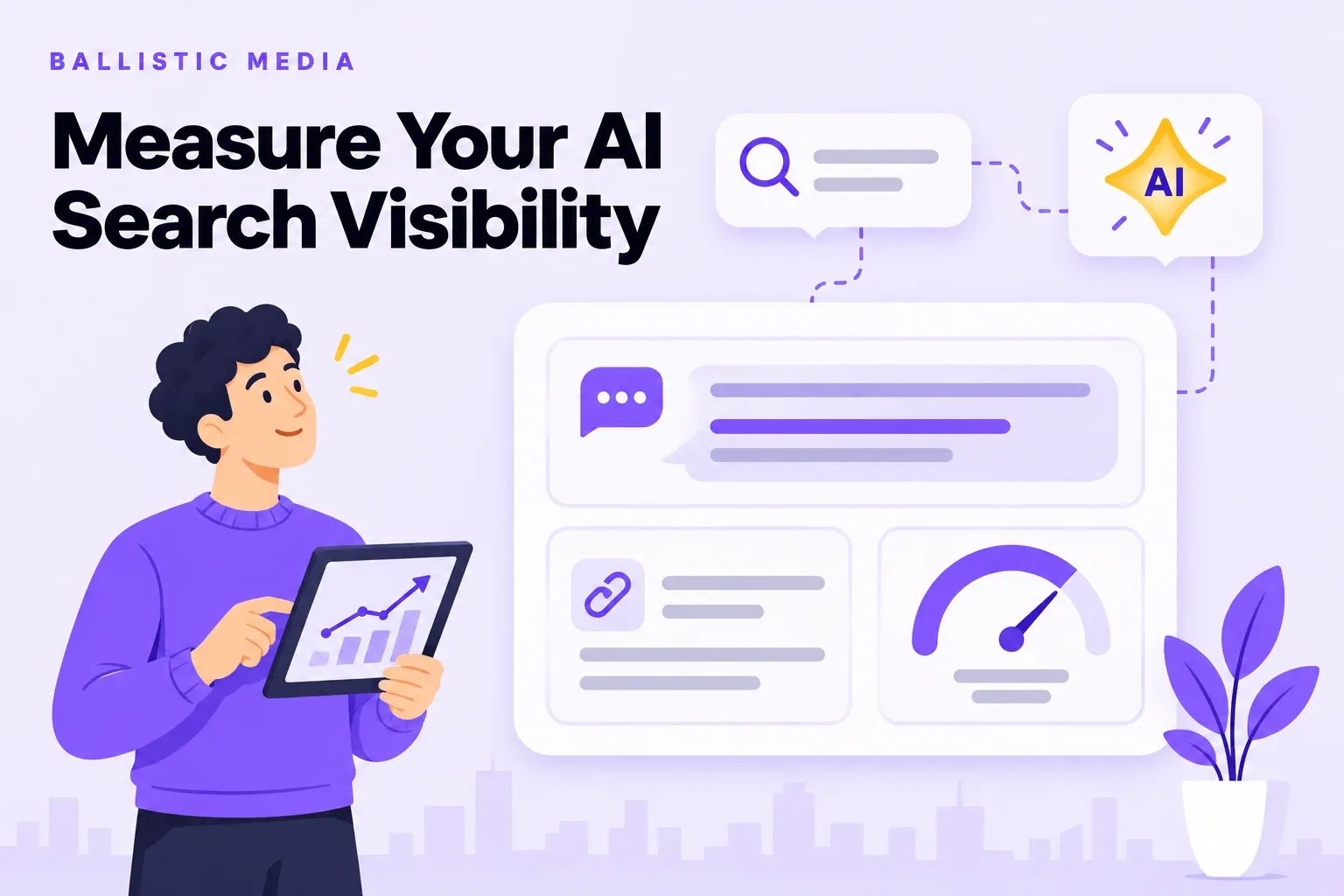
So the real question is this: if rankings and traffic aren't enough, how do you know whether your brand is becoming more visible in AI search?
The short answer: not with one metric. GEO measurement means tracking several signals on a fixed set of prompts, across several platforms, and reading them together over time. This guide gives you the framework we use in our AI search optimisation work, including the metrics, the prompt set, the data sources that exist today, and a monthly report you can run.
Key takeaways
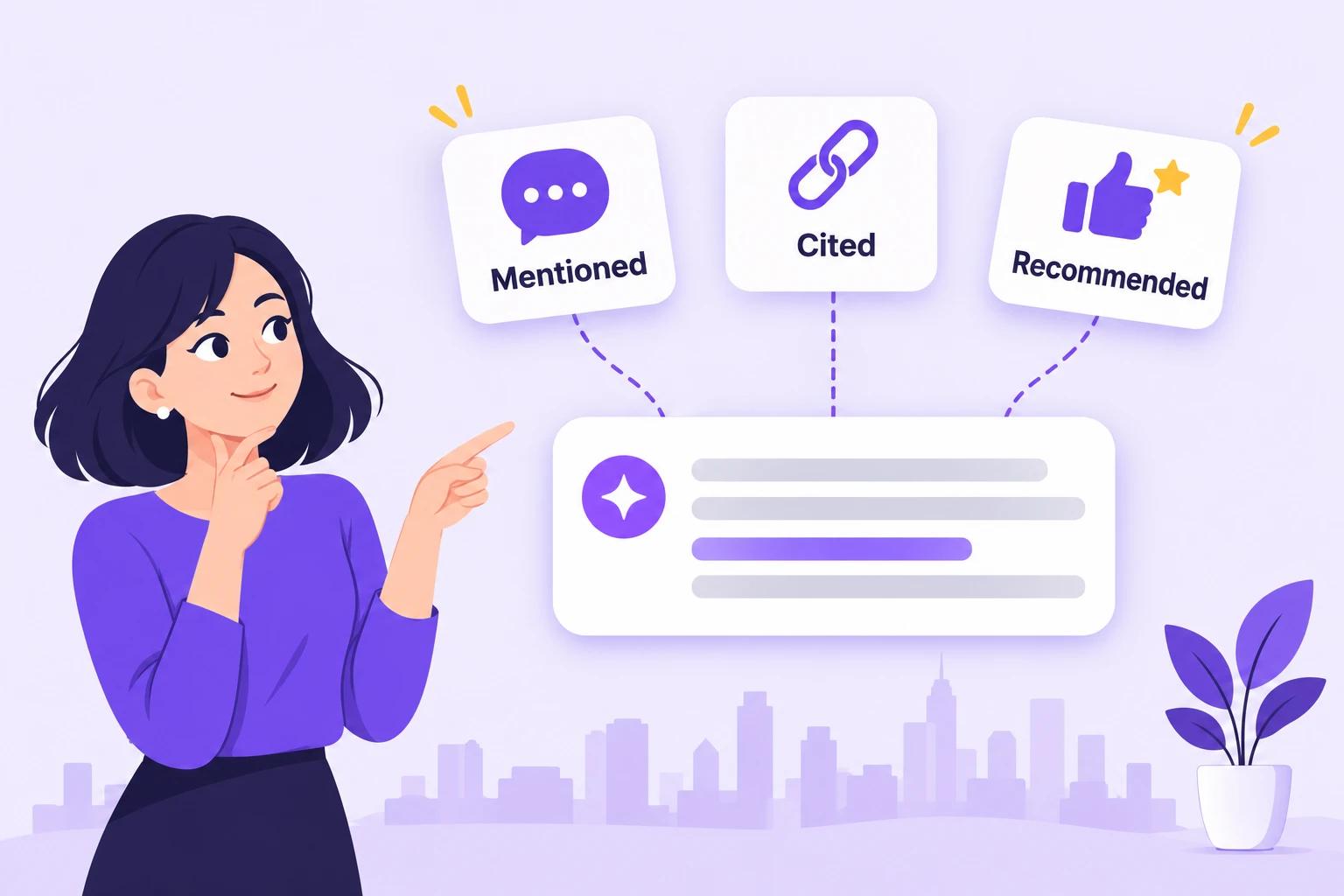
- AI visibility is three different things: being mentioned, being cited and being recommended. Track them separately.
- Everything starts with a fixed, repeatable prompt set. Random manual searches are anecdotes, not measurement.
- AI answers change between runs, so measure rates across repeated runs, never a single result.
- Google Search Console now reports AI Overviews and AI Mode impressions, but no clicks or queries. Bing Webmaster Tools reports Copilot citations. GA4 has an AI Assistant channel. None of them covers ChatGPT or Perplexity visibility.
- Accuracy matters as much as presence. Being described wrongly is worse than not being mentioned.
- Don't collapse GEO into one score. Read mentions, citations, share of voice, traffic and conversions as a set.
What does AI search visibility actually mean?
AI search visibility is how often, how prominently and how accurately your brand appears in answers generated by AI platforms such as ChatGPT, Google AI Overviews and AI Mode, Gemini, Perplexity and Microsoft Copilot, compared with your competitors, for the questions your buyers actually ask.
In practice, it can include:
- Your brand being mentioned in an AI answer
- Your website being cited as a source
- Your products or services being recommended
- Your content being used to support an answer
- How often you appear compared with competitors
- How accurately AI platforms describe your brand
The first three are often lumped together. They shouldn't be.
| Signal | What happens | Example |
|---|---|---|
| Brand mention | The AI names your company | "Agencies working in this space include Ballistic Media…" |
| Citation | The AI links your website or page as a source | Your GEO guide appears in the answer's source list |
| Recommendation | The AI actively suggests you for a relevant need | "For a B2B SaaS company, Ballistic Media is a strong option because…" |
A brand can be cited for a definition and never recommended. It can be recommended with no link at all. It can be mentioned only as a cheaper alternative to a competitor. Each of these means something different for the business, so each needs its own line in your report.
Why GEO is harder to measure than traditional SEO
GEO is not unmeasurable. It just doesn't fit the tools SEO teams grew up with.
- Answers change between searches. Run the same prompt twice and you can get two different brand lists.
- Different users get different answers. Location, language, chat history, memory and account settings all shape the response.
- Platforms use different sources and systems. ChatGPT, Perplexity, Gemini and Copilot retrieve, rank and cite content in their own ways.
- There is no traditional ranking position. There is no "position 3" in a paragraph of prose.
- A mention may produce no click. Influence happens inside the answer, not on your site.
- First-party reporting is partial. Search Console shows only part of the picture, and OpenAI and Perplexity offer site owners no equivalent report.
- The same prompt produces different winners on different platforms. Strong visibility in ChatGPT tells you little about Perplexity.
The answer is a different framework: fixed prompts, repeated runs, rates instead of single outcomes, and several signals read together.
The main GEO metrics you should track
These five metrics form the core of AI visibility measurement. Traffic and conversions come later, because they measure outcomes, not visibility.
1. AI brand mentions (mention rate)
Track how often your company appears in answers to relevant prompts.
For example, Ballistic Media might monitor prompts such as:
- Best SEO agencies in UAE
- Agencies offering AI SEO services
- Webflow development agencies in Dubai
- SEO agencies for B2B companies
- GEO agencies in UAE
The calculation is simple:
Prompts tested → prompts where your brand appeared → mention rate
If your brand appears for 18 of 100 tracked prompts:
AI Mention Rate = 18 ÷ 100 = 18%
One refinement matters. Because answers vary, run each prompt several times (three to five is a practical range) and count the runs, not just the prompts. A brand that appears in 2 of 5 runs for a prompt has a 40% mention rate on that prompt, which is very different from "appeared once, so we're in".
2. AI citations (citation rate)
A mention means the AI knows you. A citation means it trusts your content enough to use it as evidence.
For each answer, record:
- The number of citations to your domain
- Which pages are being cited
- Which topics generate citations
- Which platforms cite you
- Whether citations are increasing over time
Citation Rate = answers citing your domain ÷ total answers checked
Then look for patterns. Perhaps your research articles get cited often while your service pages rarely do. That tells you what kind of content AI systems find useful, and where to invest next.
Track third-party citations too. Often the page that gets cited isn't yours: it's a review site, a directory, a ranked listicle or a news article that mentions you. Muck Rack research presented at the 2026 AMEC Summit found that the large majority of links cited by AI come from earned, non-paid sources. If those pages describe you well, they're working for you. If they leave you out, that's a PR and outreach gap, not just a content gap.
3. Share of voice in AI search
This is the metric for competitive GEO analysis. Instead of asking only "Are we mentioned?", ask: "How often are we mentioned compared with our competitors?"
| Brand | Mentions across 100 prompts | AI share of voice |
|---|---|---|
| Brand A | 42 | 42% |
| Brand B | 27 | 27% |
| Your brand | 19 | 19% |
| Brand C | 12 | 12% |
AI Share of Voice = your brand's mentions ÷ total mentions of all tracked brands
This is a simplified, illustrative calculation. AI visibility tools calculate share of voice differently: some weight by prompt volume, some by position, some count every brand named in an answer. Whatever method you choose, keep it the same from month to month.
Mention rate and share of voice answer different questions. Mention rate tells you whether you're present. Share of voice tells you whether you're winning. Your mention rate can rise while your share of voice falls, if competitors are growing faster.
4. Position or prominence within AI answers
Being named first is not the same as appearing in the last line of an answer. Track where you appear:
- First brand recommended
- Included in the top recommendations
- Mentioned somewhere in the answer
- Mentioned only as an alternative
There is no universal "AI ranking position", so don't report one. Call it recommendation prominence instead. A simple scoring scale keeps it comparable over time, for example 3 for first recommended, 2 for top recommendations, 1 for mentioned elsewhere and 0.5 for alternative only. Average the score across the prompts where you appear.
5. Sentiment and brand accuracy
Visibility isn't useful if AI systems describe your company incorrectly.
Monitor whether your brand is presented:
- Positively
- Neutrally
- Negatively
- Accurately
- With outdated information
Then check the facts that matter most:
- Services
- Locations
- Products
- Pricing claims
- Company positioning
Brand Accuracy = correct facts ÷ facts checked
This leads to one of the most useful ideas in GEO measurement: AI visibility should be measured by both presence and accuracy. A brand that appears often but is described with an old service list, the wrong location or a competitor's pricing has a visibility problem, not a visibility win.
Build a prompt set before you start measuring
This is the step most teams skip, and it's why most GEO reporting falls apart. Random manual searches don't produce meaningful measurement. A consistent prompt set does. It's also the first thing we agree with clients in an AI visibility audit, so results stay comparable from month to month.
Group prompts around the customer journey:
| Prompt group | Example |
|---|---|
| Category / discovery | "Best digital marketing agencies in UAE" |
| Service | "Companies offering GEO services in Dubai" |
| Problem | "How can my company appear in ChatGPT recommendations?" |
| Comparison | "SEO agency vs in-house SEO team" |
| Recommendation / commercial | "Which SEO agency should a SaaS company use in UAE?" |
| Brand | "What services does [Brand] provide?" |
A few rules make the data reliable:
- Source prompts from real demand. Use long, question-style queries in Search Console, People Also Ask, sales call notes, and the questions prospects ask on Reddit and in reviews.
- Start with 30 to 100 prompts. Enough to show patterns, small enough to check by hand.
- Freeze the wording. Changing one word changes the answer. Version your prompt set and keep it fixed for at least a quarter.
- Tag every prompt by journey stage, service line, market and persona, so you can see where you're strong and where you're missing.
- Run each prompt three to five times per platform in a clean, logged-out session where possible, from the same location, and record the rate.
Measure visibility across multiple AI platforms
Don't judge GEO performance on ChatGPT alone. Depending on your audience, monitor:
- ChatGPT
- Google AI Overviews and AI Mode
- Gemini
- Perplexity
- Microsoft Copilot
The same company can be highly visible on one platform and absent on another. These platforms don't all work the same way or draw on the same sources, so report each one separately before you combine anything.
| Platform | First-party data available to site owners | How to track it |
|---|---|---|
| Google AI Overviews and AI Mode | Impressions in Search Console's generative AI report | Search Console plus prompt sampling |
| Microsoft Copilot | Citations and Citation Share in Bing Webmaster Tools | Bing Webmaster Tools plus prompt sampling |
| ChatGPT | None | Prompt sampling, a visibility tool, GA4 referrals |
| Perplexity | None | Prompt sampling, a visibility tool, GA4 referrals |
| Gemini | None separate from Google Search | Prompt sampling, a visibility tool, GA4 referrals |
Manual tracking vs AI visibility tools
You don't need an enterprise platform on day one. You do need consistency.
Manual tracking works when:
- You're just starting out
- You have 20 to 50 important prompts
- You want to understand what AI answers actually say
- Budget is limited
A simple spreadsheet is enough:
| Prompt | Platform | Run | Brand mentioned? | Position | Citation? | Cited URL | Competitors | Accuracy issues | Notes |
|---|---|---|---|---|---|---|---|---|---|
| Best SEO agencies for B2B SaaS | ChatGPT | 1 of 5 | Yes | Top 3 | No | – | Brand A, Brand B | Old office location | Recommended for fintech |
Reading the full answers by hand is valuable. It shows you how AI platforms frame your category, which sources they trust, and which claims they repeat about you.
Dedicated tools become useful when you are:
- Tracking hundreds or thousands of prompts
- Monitoring several competitors
- Comparing platforms
- Measuring trends over time
- Reporting to clients or leadership
A few places to start (for traditional SEO tooling, see our Semrush vs Ahrefs vs Rank Math comparison):
- Ahrefs AI Visibility Checker: a free one-time snapshot of brand mentions and citations across ChatGPT, Gemini, Perplexity, Copilot and Google's AI features. Ongoing tracking and share of voice sit in Ahrefs' paid Brand Radar.
- Semrush AI Search Visibility Checker: a free report covering ChatGPT, Gemini, AI Mode and AI Overviews, with a relative 0 to 100 visibility score and a competitor comparison. Limited daily checks on the free version.
- SEO Utils: a desktop SEO app with an LLM rank tracker and log-file analysis that shows which AI crawlers (such as GPTBot and PerplexityBot) are visiting your pages.
One caution: every vendor samples prompts differently, and few publish their method. A score from one tool isn't comparable with a score from another. Pick one, and stay with it for the whole reporting period.
Can Google Search Console measure AI search traffic?
Partly. Search Console is still the foundation of organic reporting. It remains the best source for:
- Search visibility
- Queries
- Pages
- Clicks
- Impressions
- Organic performance changes
Since June 2026, it also has dedicated Search generative AI performance reports, which Google rolled out to all sites by the end of August 2026. Here's what they do and don't tell you:
| The generative AI report shows | The generative AI report doesn't show |
|---|---|
| Impressions in AI Overviews and AI Mode | Clicks or CTR from AI features |
| Breakdowns by page, country, device and date | The queries or prompts behind those impressions |
| A separate view for AI features in Discover | AI Overviews and AI Mode as separate figures |
| Anything about ChatGPT, Perplexity, Gemini app or Copilot |
Clicks from AI Overviews and AI Mode still exist; they're counted within the standard Performance report alongside regular web search clicks. Two practical notes: the AI report's data only starts in mid-May 2026, and Search Console keeps just 16 months of history, so export it regularly if you want year-on-year comparisons later.
Also watch for the "alligator mouth" in your standard Performance report: impressions holding steady or rising while clicks fall. It often means your content is surfacing in AI answers that satisfy the searcher without a click.
For Microsoft's ecosystem, set up Bing Webmaster Tools. Its AI Performance report, in public preview since February 2026, shows how often your pages are cited in Copilot and Bing's AI answers, and the queries behind them. In June 2026 Microsoft added Intents, Topics, Citation Share and Compare. It's the closest thing to first-party citation data any major platform offers. Treat it as directional while it's in preview.
The bottom line: use Search Console and Bing Webmaster Tools as two inputs, not as a complete GEO reporting platform.
Track traffic coming from AI platforms
Use analytics to see what AI platforms send to your site.
Since May 2026, GA4 automatically groups recognised AI assistant visits into an AI Assistant channel in the Default Channel Group, with the medium set to ai-assistant. Find it under Reports → Acquisition → Traffic acquisition, with the primary dimension set to Session default channel group. If you want to catch sources GA4 doesn't recognise yet, build a custom channel group with a session source rule such as:
chatgpt\.com|chat\.openai\.com|perplexity\.ai|gemini\.google\.com|copilot\.microsoft\.com|claude\.ai
Then track:
- Sessions
- Landing pages
- Engagement
- Leads
- Sign-ups
- Revenue and conversions
Treat the number as a floor, not a ceiling. Some AI apps send visits without a referrer, so GA4 files them as Direct. Clicks from Google's AI Overviews and AI Mode land in Organic Search, not the AI Assistant channel.
And remember the most important point in this section: AI referral traffic and AI visibility are not the same thing. Someone can discover your brand in an AI answer, remember the name, and arrive weeks later through a branded Google search. Your AI referral report will never see that visit.
Connect AI visibility with leads and revenue
Visibility metrics only matter if they connect to the business. When AI traffic does reach your site, follow it through:
AI referral → landing page → conversion → qualified lead → revenue
If AI visitors land but don't convert, fix the page before blaming the channel. Search experience optimisation (SXO) and these ways to increase demo bookings apply to AI-referred visitors just as much as organic ones.
For businesses with longer sales cycles, add a simple question to your forms and discovery calls:
"How did you hear about us?"
Include "ChatGPT or another AI assistant" as an option, plus a free-text field. Answers like "ChatGPT recommended you" reveal AI-assisted discovery that analytics will otherwise miss.
Two indirect signals help too: branded search volume in Search Console and direct traffic. If your AI visibility rises and both trend up with no other explanation, that's a reasonable sign the influence is real, even if it can't be tied to a single click.
Create a simple GEO reporting dashboard
Here's a practical monthly reporting framework:
| Metric | What it tells you | Where it comes from |
|---|---|---|
| AI Mention Rate | How often your brand appears | Prompt set or visibility tool |
| Citation Rate | How often your site is sourced | Prompt set or visibility tool |
| AI Share of Voice | Visibility against competitors | Prompt set or visibility tool |
| Recommendation Prominence | How prominently you're suggested | Prompt set |
| Brand Accuracy | Whether AI describes you correctly | Manual review of answers |
| AI Impressions | How often Google shows your pages in AI features | Google Search Console |
| Copilot Citation Share | Your share of Copilot citations | Bing Webmaster Tools |
| AI Referral Traffic | Visits from AI platforms | GA4 |
| AI Conversions | Leads and sales from identifiable AI traffic | GA4 and CRM |
Compare these month over month and quarter over quarter. Report monthly; weekly numbers mostly capture the natural noise in AI answers. When you ship a content or PR change, give it several weeks before judging the effect on citations and mentions.
Don't measure GEO with one number
This is the most important takeaway. A company could have:
| Pattern | What it usually means | What to do |
|---|---|---|
| High citations, few recommendations | AI trusts your content as evidence but doesn't see you as an option | Strengthen commercial and comparison pages, reviews and third-party listings |
| Lots of mentions, poor brand accuracy | You're visible but misrepresented | Fix outdated facts on your site, profiles and the third-party pages AI cites |
| Low AI traffic, strong brand visibility | Influence is happening without clicks | Track branded search, direct traffic and self-reported attribution |
| Growing AI traffic, weak conversions | AI is sending the wrong visitors or the wrong landing pages | Review which prompts and pages drive the traffic, and improve the page experience |
That's why a single, arbitrary "GEO score" is dangerous when treated as absolute truth. The measurement industry has seen this before. In its 2026 GEO Principles, AMEC (the International Association for the Measurement and Evaluation of Communication) warns that AI visibility metrics risk becoming the next generation of vanity metrics if they aren't connected to awareness, trust, behaviour and business outcomes.
Look at the overall trend across mentions + citations + competitive visibility + traffic + conversions.
A 30-day plan to start measuring
- Week 1: Connect your data. Check the generative AI report in Search Console, verify your site in Bing Webmaster Tools, and confirm the AI Assistant channel is showing in GA4.
- Week 2: Build your prompt set. Write 30 to 100 prompts across the six journey groups, tag them, and choose your competitor set.
- Week 3: Run your baseline. Test each prompt three to five times on each priority platform and log the results in your spreadsheet or tool.
- Week 4: Report and prioritise. Calculate mention rate, citation rate, share of voice, prominence and accuracy, then pick the three biggest gaps to fix first.
Frequently asked questions
How do you measure GEO?
Measure GEO by running a fixed set of buyer prompts across AI platforms, repeating each prompt several times, and tracking mention rate, citation rate, share of voice, recommendation prominence and brand accuracy. Add AI impressions from Search Console, Copilot citations from Bing Webmaster Tools, and AI referral traffic and conversions from GA4.
What is a good AI mention rate?
There is no universal benchmark, because the number depends entirely on your prompt set and market. Judge it against your competitors on the same prompts, and against your own trend over time.
Can Google Search Console show ChatGPT traffic?
No. Search Console only covers Google's own surfaces. Its generative AI report shows impressions in AI Overviews and AI Mode. ChatGPT visits show up in GA4, mostly in the AI Assistant channel.
What is the difference between AI mention rate and AI share of voice?
Mention rate is the share of prompts or answers where your brand appears. Share of voice is your share of all brand mentions across those answers. One measures presence, the other measures competitive strength.
How often should you measure AI search visibility?
Monthly for reporting, and quarterly for strategy reviews. Re-baseline after major platform or model updates.
Can you measure GEO for free?
Yes, at a small scale. Search Console, Bing Webmaster Tools, GA4, a spreadsheet prompt tracker and the free Ahrefs and Semrush checkers give you a workable baseline. Paid tools earn their place once you track hundreds of prompts or several competitors.
Final thoughts
GEO success isn't simply "Do we rank in ChatGPT?" It's a sequence. Businesses should measure whether they are:
Being mentioned → being cited → being recommended → gaining visibility against competitors → driving business outcomes
Get the prompt set right, measure each step honestly, and the trend will tell you whether your brand is actually becoming more visible in AI search.
If you'd like to know where you stand today, Ballistic Media can measure your current AI search visibility, show you where competitors are winning the answer, and build an SEO and GEO strategy to close the gaps.